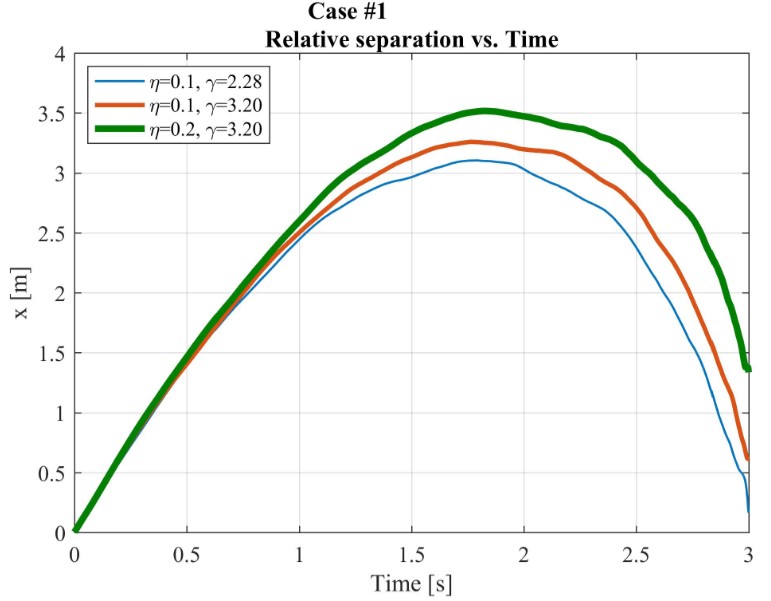
Differential Games for pursuit-evasion problems have been investigated for many years. Differential games, with linear state equations and quadratic cost functions, are called Linear Quadratic Differential Games (LQDGs). In these games, one defines two players a pursuer and an evader, where the former aims to minimize, and the latter aims to maximize the same cost function (zero-sum games). The main advantage of using the LQDG formulation is that one gets Proportional Navigation (PN) like solutions with continuous control functions. One approach which plays a main role in the LQDG literature is Disturbance Attenuation (DA), whereby target maneuvers and measurement errors are considered as external disturbances. In this approach, a general representation of the input-output relationship between disturbances and output performance measures is the DA function (or ratio). This function is bounded by the control. This work revisits and elaborates upon this approach. We introduce the equivalence between two main implementations of the DA control. We then study a representative case, a “Simple Pursuit Evasion Problem”, with perfect and imperfect information patterns. By the derivation of the analytical solution for this game, and by running some numerical simulations, we develop the optimal solution based on the critical values of the DA ratio. The qualitative and quantitative properties of the Simple Pursuit Evasion Problem, based on the critical DA ratio, are studied by extensive numerical simulations and are shown to be different from the fixed DA ratio solutions. [EuroGNC19].